The New Quiet: Texture Over Color in Kitchens
For years, luxury kitchens whispered in a singular, sterile dialect: white on white. Today, the most compelling spaces speak a richer language, where the veining of stone and the grain of wood articulate a new definition of warmth.
The design thesis behind the post-white kitchen is a quiet rebellion against sterility. It solves the problem of minimalist spaces feeling soulless by asserting that true luxury is not found in the absence of color, but in the presence of character. This approach is driven by a central idea: a dynamic equilibrium between a singular, 'loud' material and a disciplined, 'quiet' counterpart. We are moving beyond color theory and into a more profound conversation about materiality, where the inherent narrative of a stone slab or the rhythmic grain of wood becomes the primary design element.
Design Intent: Geological Minimalism
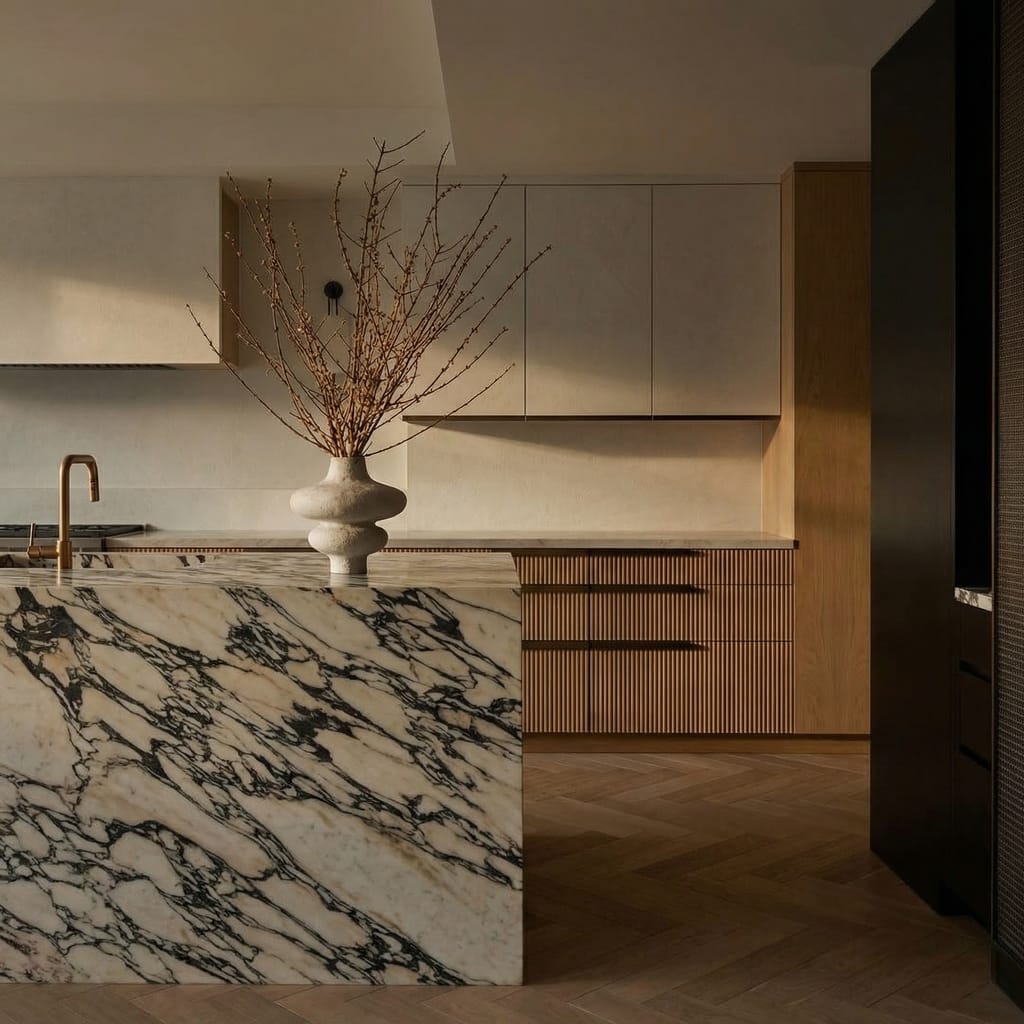
The conceptual framework was to design a space that feels both elemental and meticulously controlled. Moving away from the 'clinical' minimalism of the past decade, the intent was to anchor the kitchen's social and functional core with a monolithic island that reads as a piece of geological art. The primary design move was to treat the Breccia marble island as a formidable sculpture and then wrap the perimeter in the quiet, orderly rhythm of fluted oak casework. This establishes a clear visual hierarchy, allowing the stone's dramatic personality to command attention without overwhelming the senses, creating a space that is serene yet alive.
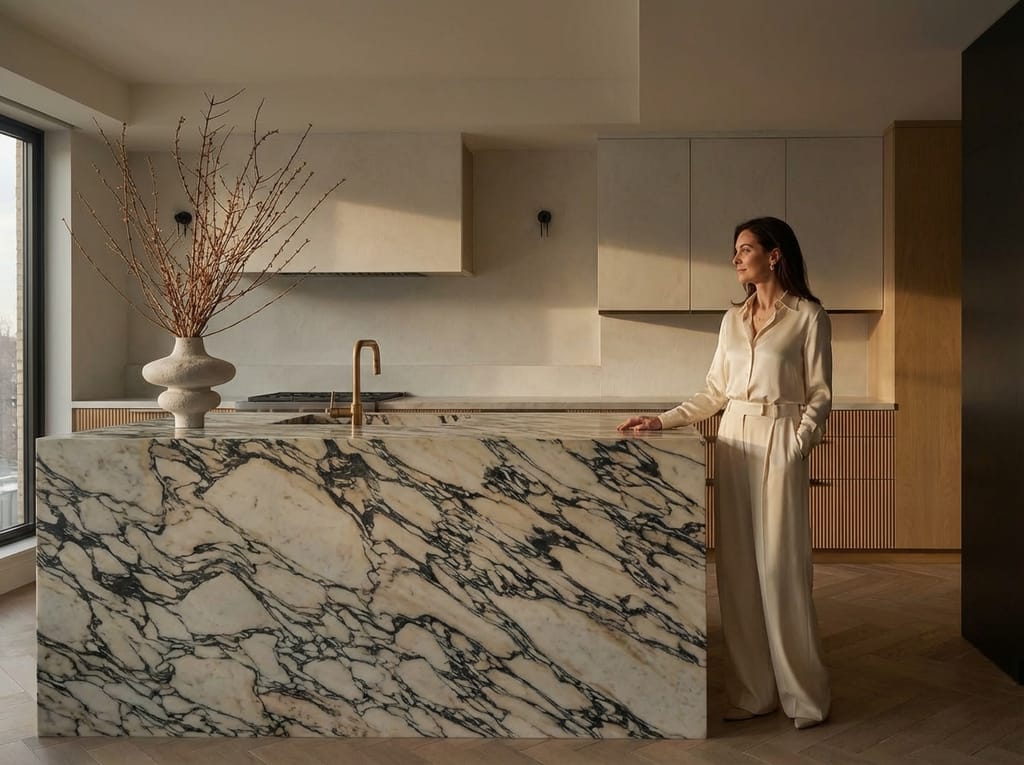
We aimed for a minimalism that feels geological, not clinical. The goal wasn't to eliminate character, but to distill it.
Material Palette: A Controlled Dialogue
The material selection was an exercise in curated contrast. The protagonist is a heavily-veined Breccia marble, chosen for its chaotic, expressive movement. Its surface is honed, not polished, to give it a soft, chalky tactility that absorbs light rather than reflecting it. This creates a more profound sense of depth. In response, the perimeter millwork is crafted from quarter-sawn white oak, its vertical fluting creating a disciplined, repeating pattern. The wood's grain is straight and consistent, and the finish is a clear, matte sealant that preserves its natural warmth. This juxtaposition—the wildness of the stone and the uniformity of the wood—creates a visual and textural dialogue that is the heart of the design.
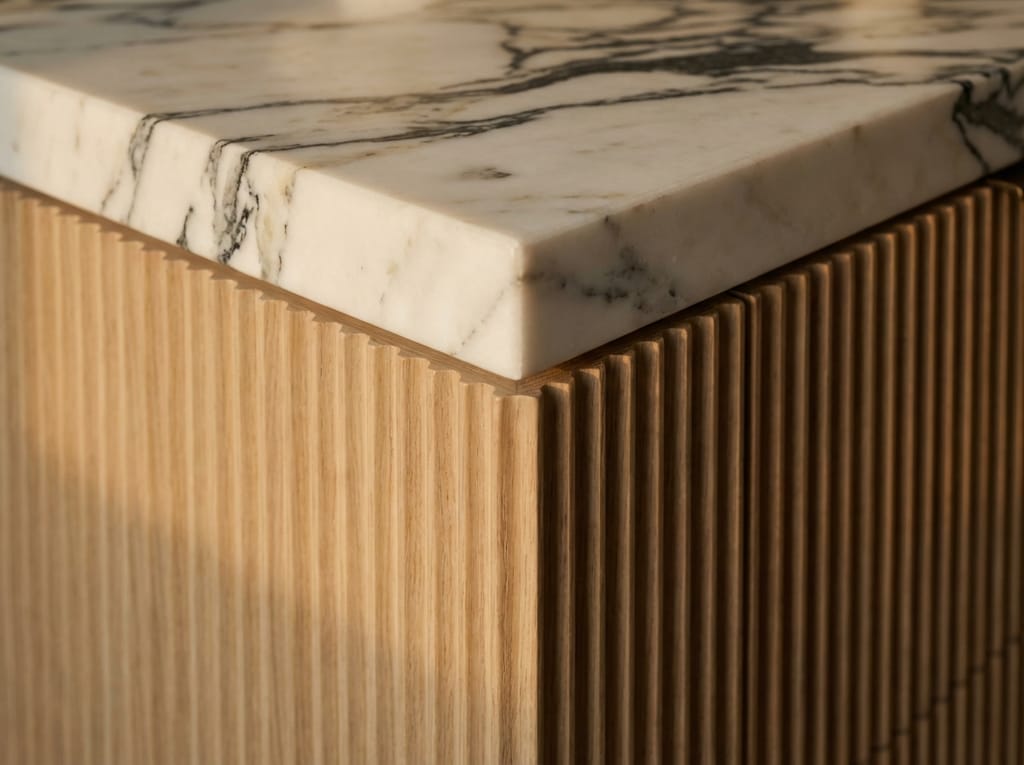
The dialogue is everything. The stone brings the drama; the wood provides the disciplined rhythm that contains it.
Spatial Experience: Light, Rhythm, and Form
The space performs as a gallery for daily life. Morning light washes across the honed marble, revealing the subtle complexities of its mineral deposits without harsh glare. As the day progresses, the sun's angle catches the fluted oak, casting rhythmic, moving shadows that animate the kitchen's perimeter. Circulation is choreographed to flow around the island, reinforcing its status as a central monument. Functionally, the quiet perimeter houses the mechanics of the kitchen, while the island serves as the stage. The wood also provides acoustic dampening, creating a comfortable soundscape rarely found in stone-dominant interiors. It is a space designed for both effortless function and quiet contemplation.
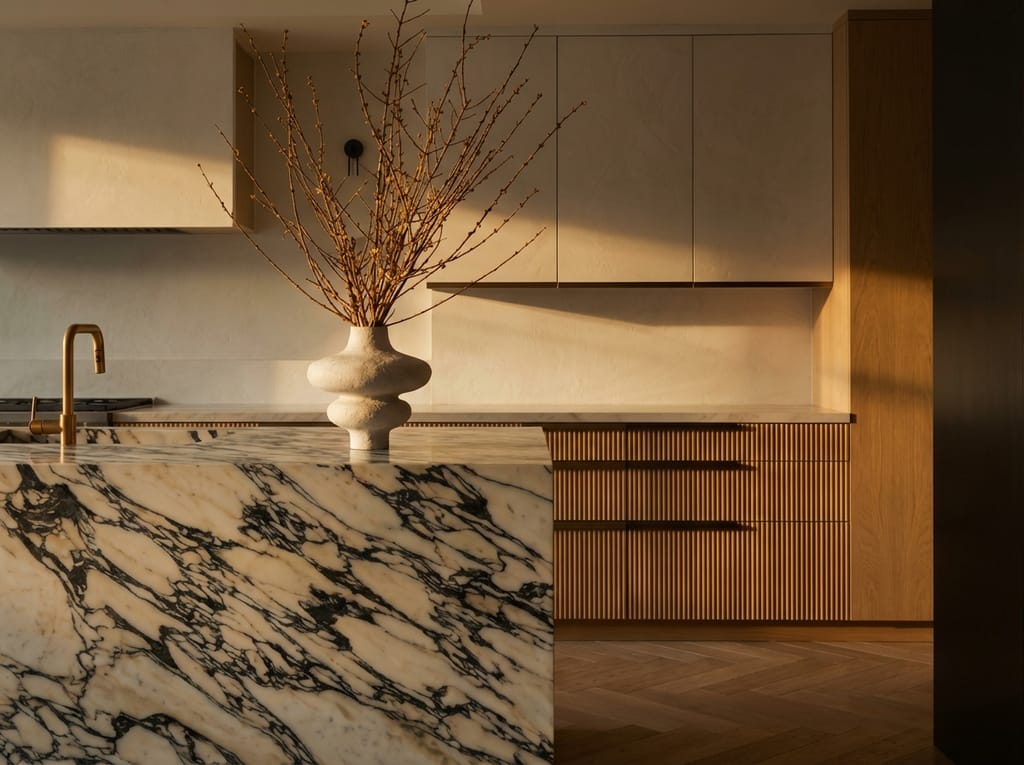
It’s a space that calms the mind but engages the eye. You feel the quiet of the architecture and the energy of the earth itself.
This shift toward material-forward design marks a maturation in our understanding of luxury. It is a move away from transient trends and toward a concept of organic permanence—investing in elemental materials that carry an innate history and will acquire a patina of life with grace. By allowing texture, grain, and vein to replace bold color, we create spaces that are not merely decorated, but are fundamentally composed. This is more than a kitchen; it is a lasting statement on the value of authenticity and enduring craft in the most vital spaces we inhabit.